AI is shifting from experimental projects to practical tools in business travel, with companies focusing on real-world applications like expense control, compliance, and itinerary management.
For years, artificial intelligence in corporate travel was largely theoretical—limited to pilots and early-stage experiments. That is now changing, as travel programs begin integrating AI into everyday operations. Industry data suggests adoption is widespread, but still developing.
Most Travel Programs Are Testing AI—Few Have Fully Adopted It
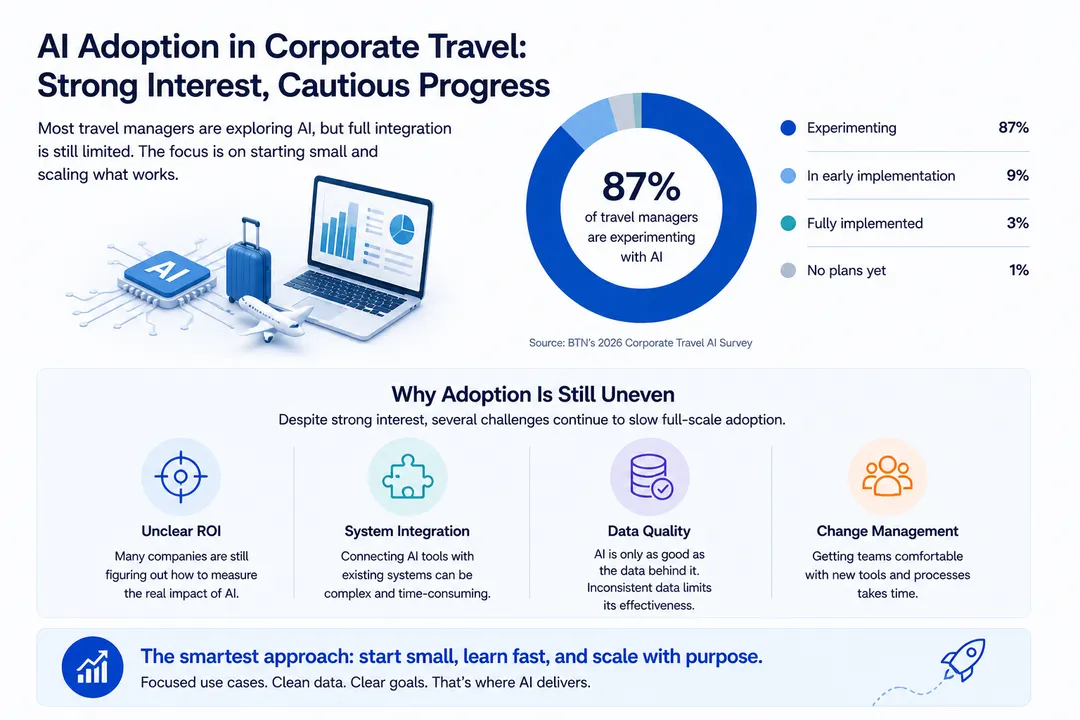
According to , nearly 90% of travel managers report experimenting with AI tools. However, only a small share have fully embedded these technologies across their workflows.
A similar trend appears in , which shows companies prioritizing targeted use cases rather than large-scale transformations.
This suggests AI adoption in travel is entering a transitional phase—moving from testing into selective, operational use.
Practical Use Cases Are Driving Adoption
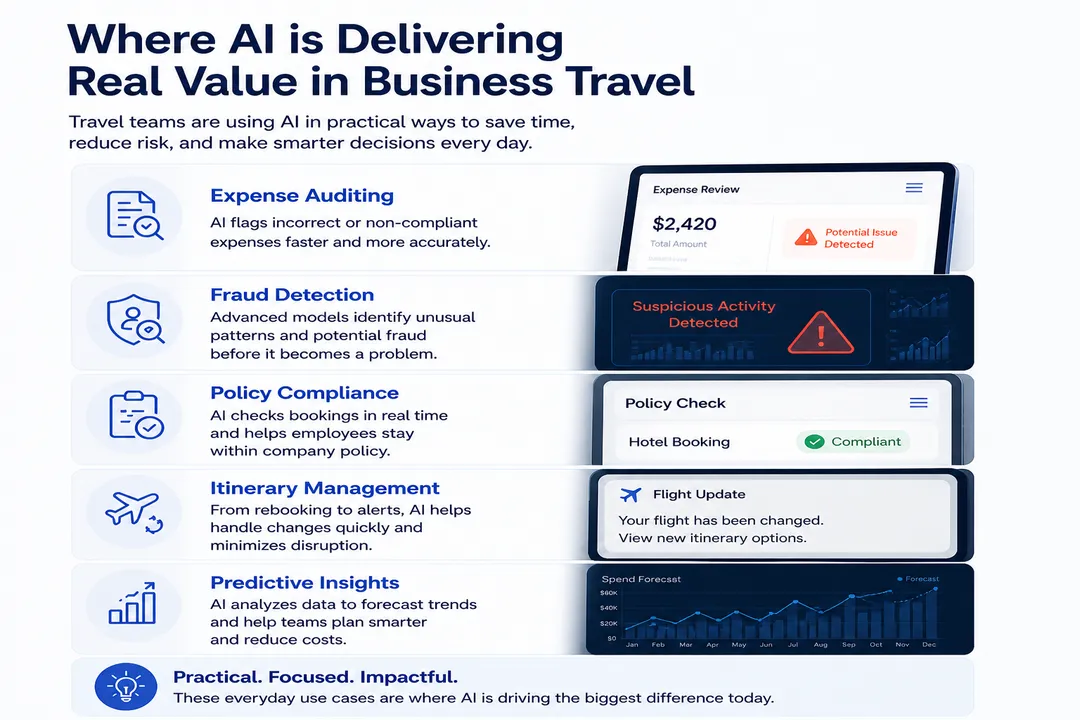
Rather than broad overhauls, companies are focusing on specific areas where AI delivers immediate value:
-
- Expense auditing
- Fraud detection
- Policy compliance
- Itinerary management
- Data analysis
These use cases are helping travel teams improve efficiency without requiring major system changes.
Adoption Remains Slower Than Expected
Despite strong interest, several barriers continue to slow adoption:
- Difficulty measuring return on investment
- Integration challenges with existing systems
- Inconsistent or poor-quality data
- Organizational resistance to change
Research from also highlights concerns around fraud risks and data reliability.
As a result, most companies are taking incremental steps—testing specific applications and expanding gradually.
A Shift Toward Operational AI
Rather than being viewed as a long-term innovation project, AI is increasingly treated as a tool that supports daily operations—particularly in cost control, efficiency, and compliance.
Outlook
AI is unlikely to transform corporate travel overnight. However, its role is steadily expanding as companies identify practical ways to integrate it into existing workflows.